
How to Move a Treadmill
Installing a treadmill in your home is a great way to stay in shape but moving it can be a headache. While most people prefer to hire a professional to disassemble their home exercise equipment, it’s not always necessary. Despite their moving parts and electronics, most treadmills are relatively simple devices that can be taken apart and transported without professional assistance. If you’re considering the DIY approach but don’t know how to move a treadmill, this step-by-step guide will walk you through the process.
Gather Your Tools
Disassembling a treadmill doesn’t require any specialized tools. It’s likely most of the equipment you need is already in your home and what you don’t have can be easily purchased from your local hardware store. This includes:
- Philips Screwdriver
- Allen Wrench
- Socket Wrench with Multiple Sizes
- Furniture Dolly Rated for 600 Pounds or More
- Moving Blankets
- Plastic Stretch Wrap
- Bubble Wrap
- Packing Peanuts
- Packing Tape
- Ratchet Straps
- Resealable Plastic Bags (For Hardware)
- Permanent Marker
- Moving Boxes
- Cardboard Sheets
In addition to your tools and moving supplies, you’ll also need at least 2-3 people to help you lift and maneuver the treadmill through your home. A standard treadmill weighs 200-300 pounds, and its weight is not evenly distributed. Because of the motor, treadmills are heavier in front than in back, which can make them tricky to handle, compared to ordinary furniture.
Check Your Owner’s Manual
In addition to operating guidelines, most owner’s manuals contain specific instructions for assembly and disassembly. They also contain important information you may need to consult during shipping and setup, such as:
- Type, Brand, and Model
- Approximate Weight
- Height, Width, and Length
- Power Requirements (120 volts, 240 volts, etc.)
If you can’t find your owner’s manual, you can usually download it off the manufacturer’s website. YouTube is also a good resource. Search for videos about how to disassemble and transport treadmills. Odds are there’s one that covers your specific make and model.
On the off chance you can’t find any, search for videos that explain how to assemble your treadmill and follow the steps in reverse. However, before you begin, review your warranty to make sure you won’t void your coverage by working on your treadmill without professional assistance.
Plan Your Route
Treadmills are not designed to glide easily down corridors. They’re large and clunky, which means they don’t always fit through standard hallways and entryways. Before disassembling your treadmill, take a moment to measure the corners, ceilings, and doors along your route, to make sure they’re big enough to accommodate your equipment. Sometimes the shortest path through your home contains tight spaces you can’t maneuver around, while a longer one is easier to navigate.
Protect Floors and Doorframes
Once you’ve finished planning your route, cover up the exposed points along the way. Treadmills are large, bulky, and can seriously damage corners, door frames, countertops, and bannisters if you’re not careful. Common issues include:
- Scuffs
- Scratches
- Dents
- Splintered Woodwork
- Damaged Drywall
- Gouged Floors
- Broken Tiles
- Torn Carpets
- Cracked Door Jambs
Protect your home, lay cardboard or moving blankets along your route and tape them down to keep them from shifting. Choose a dolly with wide, rubber wheels instead of plastic ones. Distributing weight over a wide area prevents it from creating grooves in your floor. Cover your doorways, countertops, and bannisters with blankets and cardboard, so you won’t leave a mark if you accidentally bump into them.
How to Dismantle Your Treadmill
Once your precautions are in place, it’s time to dismantle your treadmill. To prepare it for transport:
- Unplug the power cord and tape it to the frame.
- Remove any accessories, such as cup holders, safety keys, or tablet mounts.
- Fold the deck and engage the locking mechanism. Most treadmills sold in the last 20 years can be folded up ‒ a space saving feature that’s convenient for moving. If your deck doesn’t fold, you’ll need to detach it by removing the deck-to-frame bolts. Keep the rollers, deck, belt, and bolts together in one place so you can pack them later.
- Detach the console according to the manufacturer’s instructions. Take a picture of the wire connections first, so you have a visual guide when you’re putting it back together again.
- After carefully disconnecting the wires, remove the console and wrap it in bubble wrap. Because it’s delicate, experts recommend transporting it in your car instead of a moving van.
- Wrap the treadmill in moving blankets and use plastic stretch wrap to hold them in place, to protect them from bumps and jolts during transport.
If you removed the deck, wrap it in a thick layer of bubble wrap. It’s probably too big to be boxed up, so you’ll have to wedge it securely alongside the treadmill after it’s loaded onto the truck. The rollers should be covered in bubble wrap and boxed up, along with the belt. Fill any space in the box with packing peanuts.
Any bolts should be placed in a plastic bag and clearly labeled. Place them in the box with the rollers or tape them to the treadmill. Finally, place your accessories in a box as well, with packing peanuts for cushioning.
How to Move Your Treadmill
Because of its size, your treadmill should be one of the first items you load onto the moving truck. Start by lifting it onto the dolly front end first, then secure it with ratchet straps.
Roll it through your house and out to the van. Have one person out front guiding it while everyone else pushes from the back. Don’t tilt it. The shifting weight might put stress on the motor.
Once you reach the truck, place the treadmill against the side of the van and strap it in place. Don’t stack any boxes or items on top of it. The added weight could lead to damage.
Reassembling Your Treadmill
When you arrive at your new home, before you start unloading, inspect the room where you’ll be setting up your treadmill. Locate the outlets, check ventilation, and make sure the floors are even. Most treadmills are designed to function with a standard, 120-volt outlet, but if your model requires extra power, you may need to consult an electrician. Newer models function like computers, with sophisticated electronics that are sensitive to power fluctuations. Instead of plugging them directly into the wall, you may want to connect them to a power strip with surge protection to prevent damage.
Once you’ve finished inspecting the room, make sure there is a clear path through your home and then unload the treadmill with the help of 2-3 people. Like before, you may want to cover the doorframes, corners, and bannisters along the route to avoid damaging your home.
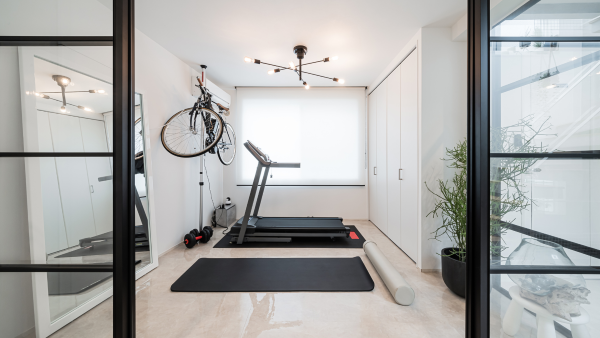
After you’ve gotten it into your home gym, reassemble it by following the steps above in reverse order. If you can, set up your treadmill in front of a window. It not only provides a nice view, but increases exposure to natural light, which creates a pleasant, less claustrophobic environment, conducive to exercise.
When to Consider Professional Help
Treadmills are one of the easiest exercise machines to move, but can be challenging under certain circumstances. Ask a professional moving team for help if:
- Your treadmill weighs over 300 pounds
- Your current location or new location requires you to carry it upstairs or downstairs
- You have difficulty lifting 50 pounds on your own
- Your machine is under warranty
There are also some treadmills, such as the ones produced by Peloton, Technogym, and Precor, with sensitive technology that should only be handled by people specifically trained to repair and dismantle it, otherwise you run the risk of miscalibrations, safety issues, and permanent damage.
North American Moving Services
North American Van Lines delivers reliable, full-service moving solutions to households in Canada and the United States. For nearly a century, we’ve packed, transported, and stored all types of specialty objects, everything from treadmills to pool tables and grand pianos. No matter how big the job, we have the tools, skills, and experience to tackle it. Contact us today for a free quote!
